Featured Posts

Decoration

All Posts
Showing posts with label FREEDOM. Show all posts

Thursday, 20 April 2017

AN OPEN HOUSE, BY LEONOR ANTUNES


Two weeks after the election of Donald Trump, I held a small event in Amsterdam in a place called the Hubertus House, which was designed by the architect Aldo van Eyck in 1959. I called it An Open House. I have been working on this project for quite a long time; I was invited to do it by the curating collective If I Can’t Dance I Don’t Want to Be Part of Your Revolution. Van Eyck designed two interconnected buildings to host single mothers and their children in a private foundation that provided day care, as well as other support. Initially, I didn’t plan to work on this project in the way that I did but after the shock of the election, I couldn’t think of anything else apart from reacting somehow. 

The project included 12 women, myself included, from different backgrounds and origins – we all look very different from each other. Tess van Eyck, the architect’s daughter, joined us, sitting on a sofa reading her newspaper. For one hour, we all stood on the balconies of the building and behind the windows. The public was told nothing about what they might see; they were allowed access to one of the two buildings, but not the one we were occupying. We were all dressed in the 12 different colours that Van Eyck used.

(Text published on frieze.com
23:16 - By Unknown 0

Tuesday, 18 April 2017

LANGUAGE (PROPERTY), BY DANIEL ANDÚJAR


Daniel García Andújar – the Spanish media artist better known by his company name Technologies To The People — almost ten years ago created with Language (property) a work addressing the increasing privatization and commodification of language. A plain HTML page presents a list of sentences that have become registered trademarks and thus the property of their corporate owners. Examples include »Where do you want to go today?™« (Microsoft), »A better return on information ™« (SAP), »Moving at the speed of business™« (UPS), »What you never thought possible™« (Motorola). By giving his project the title Remember, language is not free™, Andújar anticipated the disputes surrounding ›intellectual property‹ in the following years (and increasingly evident in the second half of the 1990s with the ruthless scramble for domain names in the World Wide Web). While on the website the individual sentences are linked to the copyright notices of the relevant companies, a large-format, almost ›immersive‹, wall has been chosen for the exhibition.

13:52 - By Unknown 0

Wednesday, 21 December 2016

HI GENTLEMAN, BY ROZHGAR MUSTAFA


A Kurdish artist who lives in Sulaimani where she graduated from the university of fine arts in 2004, she teaches art in secondary school.
In her own words, Rozhgar Mustafa describes this artwork: "I used to produce my own bra when I was a teenager, because I couldn’t deal with my adulthood, my relatives told me that it is impossible to go out and play with my friends as because I passed my age twelve. Therefore I was thinking of hiding my breast to appear like a boy, and I usually had my hair cut by my brother as exactly as a boy for next four years. Since I had passed that period I always found myself under an extremely difficult social and political condition, which takes a decision based on my gender, from then I have been demanding the position of being a girl or a boy."


13:25 - By Unknown 0

Friday, 11 November 2016

2487, BY LUZ MARÍA SÁNCHEZ


2487 speaks the names of two thousand four hundred eighty-seven persons who were found dead throughout the border region of Mexico and the United States. Effectually giving voice to diaspora, Sanchez’s eight-channel sound piece evolves into an audible terrain where names are generated from various positions marking the varying directions of movement across the border. Each death, that was recorded and filed, has been audibly re-recorded and re-filed by the artist as individual sound files composed to play randomly, initiating organic patterns much like migration patterns themselves. Interspersed with varying periods of silence, some names are heard in isolation while others sound like links in a chain, and many overlap. As two thousand four hundred eighty-seven names are spoken the changing pace that speaks them disrupts any sense of repetition allowing the piece to extend beyond the serial monotony of name-calling. The random pattern employed in the voicing of these persons, these deaths, offers both moments of contemplation and anxiety with periods of doubt in between. That one can’t actually hear all the names, as some merge into others or are overlaid, underscores the immensity and gravity of what is being called for, not just called out—the intractability of 2487… and 2488, and 2489, and 2490 and… . More than just enunciating the sounds of each identity 2487 annunciates a calculated instability, a tension that quietly resonates throughout the piece.

A PDF with information about the individuals featured in 2487 is available for download here. For more information about Sánchez’s ongoing project on the Mexican diaspora, visit diaspora2487.org.

19:04 - By Unknown 0

Tuesday, 8 November 2016

OPERATION ONYMOUS (FBI INVESTIGATION OF THE SILK ROAD) AND CODE NAMES OF THE SURVEILLANCE STATE, BY TREVOR PAGLEN


As cyber threats increasingly push security efforts into virtual realms, Trevor Paglen’s work examines the many facets of government intelligence. Installed in a building that once served as home to the 902nd Military Intelligence Group — in a vault that housed classified documents — Operation Onymous (FBI Investigation of the Silk Road) invokes the motif of an FBI challenge coin, a cryptic medallion recognizing an agent’s affiliation with the organization; the coin featured here was given to those who aided the takedown of the notorious Silk Road darknet market in San Francisco. Code Names of the Surveillance State presents a scrolling list of more than 4,000 code names used by the National Security Agency (NSA) and Government Communications Headquarters (GCHQ) for surveillance programs.


18:51 - By Unknown 0

Friday, 4 November 2016

EXODUS, BY MANDANA MOGHADDAM


Mandana Moghaddam knows firsthand the refugee’s sense of loss and displacement, hope and renewal. At age 21 she fled Iran after her father was executed in the revolution and she was barred from higher education as a penalty for political activities. After five years in transition in Turkey, she was granted asylum in Sweden, where she lives today. Her video installation captures that experience through the motion of suitcases adrift on the ocean, lost in passage — the baggage of our worldly goods that both protect us and expose us, cloak us and mark us as individuals or as members of a certain culture. The uncertainty of their delicate dance on the waves, and the comfort of reaching solid ground, evoke empathy and a desolate sense of loss, amplified by the sheer simplicity and beauty of the images.

18:45 - By Unknown 0

Tuesday, 1 November 2016

1 KG OF SOIL, BY AMER AKEL

Installation show in Kunsthalle Exnergasse (Vienna) 2015, in collaboration with Allartnow.

"What if the only remaining thing from Home is a few letters ... memories ...and a handful of soil....."
I didn't realise that obtaining handful Soil of Syria would be such a difficult mission. After numerous attempts that lasted a month and with some assistance from my friends I have managed to get 1kg of soil in order to achieve this project. It was a post journey from Damascus to Vienna... via Beirut...once I have received the postage and when I touched the soil I instantly had a strange feeling ...This is where the question of ' what is home?' has badly urged me (Amer Akel).


16:08 - By Unknown 0

Monday, 26 September 2016

LEVEL OF CONFIDENCE, BY RAFAEL LOZANO-HEMMER


"Level of Confidence" is an art project to commemorate the mass kidnapping of 43 students from the Ayotzinapa normalista school in Iguala, Guerrero, Mexico. It was released on March 26, 2015, exactly six months after the kidnapping took place. The project consists of a face-recognition camera that has been trained to tirelessly look for the faces of the disappeared students. As you stand in front of the camera, the system uses algorithms to find which student's facial features look most like yours and gives a "level of confidence" on how accurate the match is, in percent.

The biometric surveillance algorithms used, -Eigen, Fisher and LBPH-, are typically used by military and police forces to look for suspicious individuals whereas in this project they are used to search for victims instead. The piece will always fail to make a positive match, as we know that the students were likely murdered and burnt in a massacre where government, police forces and drug cartels were involved, but the commemorative side of the project is the relentless search for the students and the overlap of their image with the public's own facial features.


22:26 - By Unknown 0

Monday, 29 August 2016

DE VLUCHT, BY WOUTER OSTERHOLT


The sugar sculpture is a copy of an existing monument, titled ‘De Vlucht’ (The Refuge) made by the Dutch sculptor Hein Koreman, located in the Valkenberg Park in the city center of Breda. Every year on the 4th of May this monument is used to commemorate the casualties of the Second World War, but in particular it reminds us of the so-called ‘Vlucht van Breda’. On the 12th of May 1940 the citizens of Breda fled their city due to the impending war.

09:00 - By Unknown 0

Wednesday, 6 July 2016

SPOTS OF TIME, BY ROB JOHANNESMA

2013 / Refugees, Spots Of Time


The tension between the desire for radical change and the seeming intransigence of certain institutions that led artist Johannesma to create Spots of Time (2013). The work is a multichannel digital slide show that presents a compilation of newspaper pages and photographs from 2008 to the present that capture this phenomenon. As re-photographed by the artist multiple times and transferred to a different medium, each image guides our view beyond its immediate take as news to a more abstract reading of information. Although the language of the archive might seem incompatible with the spectacular nature of revolutions, Johannesma uses his role as an artist who understands and appreciates the complexities of image-making to create a compendium of the architecture, the objects, and the issues of freedom and citizenship embroiled in such occurrences. His conservation of moments of these ongoing struggles stands as an example of what playwright Bertolt Brecht called ermattungstaktik (‘tactics of attrition’), and the creative efforts of imagination and dedication, through which, however short the duration, the challenges of this world will eventually give way.
Clare Butcher

10:00 - By Unknown 0

Sunday, 3 July 2016

STANDING MAN, BY ERDEM GÜNDÜZ


Erdem Gündüz is a Turkish dancer, actor, performance artist, choreographer, and teacher who, as a result of his actions during the 2013–14 protests in Turkey, has become "the face of the protest movement against the Turkish government." He became internationally known as "The Standing Man" in June 2013 when he stood quietly in Istanbul's Taksim Square as a protest against the Islamist government of Recep Tayyip Erdoğan.


14:01 - By Enrique Veganzones 0

Sunday, 10 April 2016

ARCHIVE, BY ARKADI ZAIDES


Arkadi Zaides is an independent choreographer. He was born in the Soviet Union in 1979, and immigrated to Israel in 1990. Today he lives and works in Tel Aviv.

Archive, a solo by Arkadi Zaides, derives its source from the video archives of B’Tselem, a human rights information centre that gives cameras to Palestinians so that they can film their day-to-day lives in the occupied territories. On stage, the dancer and choreographer parades images of everyday violence between Palestinians and the settlers. He faces them and, as if looking for his place among them, reproduces the postures of the figures on screen. He glides from one body to the next, becoming a teenager throwing stones, a soldier firing teargas, an injured person being carried away… He extends certain movements, repeats others on a loop and, like an insane conductor, constructs a dance filled with gestures of violence. In turn playing a filter, a magnifying glass or a frame or hiding it altogether, Zaides continually moves around, shifting what we are seeing. He creates a maelstrom of sensations, a body-archive for us to delve into.

 
13:07 - By Unknown 0

Friday, 26 February 2016

STATE OF PALESTINE, BY KHALED JARRAR


Khaled Jarrar, a Palestinian artist, decided to declare the existence of a non-existent state. He created a passport stamp for the State of Palestine, challenging the Israeli border regime. Jarrar undertook his first stamping action at the central bus station in Ramallah for people arriving from the checkpoints. When he goes abroad, he uses any occasion to mark people’s passports (a couple hundred so far) and thereby develops a campaign based on nonviolent resistance. These stamps represent a sovereign independent country and opposition to the violent fragmentation of the Palestinian territory. Those who agree to have the stamp put into their documents sustain claims for Palestinian sovereignty and perform an individual political coming out which defines one’s position.


A community of supporters grows. Official documents become a manifestation of citizen’s disobedience. And if you have a stamp, you might run into trouble: your entrance to Israel might be denied by border control at the Ben Gurion checkpoint, or you might be sent back to your country of origin. We even know of Israeli passports that have been cancelled due to the unauthorized stamp. Together with the 7th Berlin Biennale, Jarrar also produces postage stamps from Deutsche Post, which have a Palestine Sunbird and the inscription "State of Palestine" printed on them. Over 20,000 have been made so far. Used on letters and postcards, they have circulated worldwide.


Jarrar’s passport and postage stamps tell the story of a state-to-be. But reality goes against him and other Palestinians. Instead of continuing again and again the discussion about a one- or two-state solution, using these stamps is a simple gesture that helps to create normality.

20:12 - By Unknown 1

EL SILUETAZO, BY EDUARDO GIL


"The realisation of silhouettes is the most memorable of the artistic-political practices that lent a powerful visuality to the public space of Buenos Aires and many other cities of the country on the demands of the argentinian human rights movements in the early 1980s. This consist of a simple design in the form of the outline of a man-sized body on paper, later pasted on the city walls as a way of representing the 'presence of an absence' of the thousands of prisioners who 'disappeared' during the last military dictatorship" (text by Ana Longoni).
This video by Marcelo Expósito includes interviews with the art historian and researcher Ana Longoni, and Guillermo Kexel (one of the three artists who originally conceived 'El Siluetazo', before this practice was adopted and pushed forward by Madres de Plaza de Mayo in 1983), as well as original photographs by Guillermo Kexel and Eduardo Gil. This video is part of the collective research project: "Images of 'El Siluetazo' and other creative strategies of the human rights movement in Argentina", carried out by Fernanda Carvajal, Marcelo Expósito, Cora Gamarnik, Ana Longoni and Jaime Vindel, within the framework of the Red Conceptualismos del Sur / Southern Conceptualisms Network, produced by Museo Reina Sofía, Madrid (2010-2011).


19:58 - By Unknown 0

LOOKING FOR A HUSBAND WITH EU PASSPORT, BY TANIA OSTOJIĆ


In August 2000 Tanja Ostojić launched her project Looking for a Husband with EU Passport in which she published an online advertisement with the same title. Over the next few months the artist received numerous offers from men from around the world, and exchanged more than 500 letters with them. One of them was Klemens G. from Germany. Ostojić met him in 2001, as part of a publicly staged performance on the lawn in front of the Museum of Contemporary Art in Belgrade. One month later the two were wed in Belgrade, and then—with the international marriage certificate and other necessary documents in hand—Ostojić applied for a German visa. With her first three-month visa she moved to Düsseldorf, where she registered officially with the authorities and received additional visa extensions over the next three-and-a-half years. In the spring of 2005 her temporary residence permit expired and, instead of receiving a permanent residence permit, Ostojić was only granted an extension for an additional two years. Subsequently, she and Klemens G. divorced, and on July 1 the installation Integration Project Office was launched in the project room of Galerie 35 in Berlin, with a divorce celebration.
With her project Looking for a Husband with EU Passport Ostojić addresses the political injustices, exclusions, and delimitations that still exist in Europe beyond the global digital realm. Ostojić made use of the World Wide Web to shed light on the plight of immigrants and the limitations imposed on lifestyles, through artistic self-exploration.

Tanja Ostojić's website.
06:55 - By Unknown 1

REMOTEWORDS, BY ACHIM MOHNÉ AND UTA KOPP


The long-term project Remotewords disseminates news that can only be viewed from above and from outer space. The roof of the Kumu Art Museum in Tallinn has become the project’s sixteenth station worldwide; it bears a message that cannot be seen from the ground but will be visible and shared around the world through Google Earth and other navigation systems as soon as the satellite images are updated. The artists will create permanent messages in the form of large letters painted on the rooftops. Additional writers, artists, and scholars have been invited to join in developing key messages appropriate to the site and its function. The website of Remotewords embeds the coordinates of each location directly into Google Earth or Google. Photographic and video documentations as well as interviews with the authors and information about the sites deepen the semantic connection between place and message.
Remotewords is about the power and powerlessness of digital observational and communications systems. The project provides a response to the increasing commercialization of the Internet, with messages and news that use Google Earth as an artistic medium. And Google Earth’s suggested promise of real time is unmasked as an illusion, since the messages can only be read in the Internet after the satellite data is updated, and this in turn depends on the relevance of the site within the global network.

Achim Mohné's website.
Uta Kopp's website.
06:48 - By Unknown 0

NIKE GROUND, BY EVA AND FRANCO MATTES


Eva and Franco Mattes, born 1976, are the Brooklyn based artist-provocateurs behind the infamous Web site 0100101110101101.org. Since meeting in Madrid in 1994 they have never separated, living a nomadic life throughout Europe and the United States. Among the pioneers of the Net Art movement, they are renowned for their masterful subversion of public media. Over the last fifteen years, the Mattes’ have manipulated video games, Internet technologies, feature films, and street advertising to reveal truths concealed by contemporary society. Their works create a permanent state of insecurity by blurring borders between reality and fiction, art and offence, intention and action. Their off-the-wall performances—which have involved them in several lawsuits—include stealing dozens of fragments from art masterpieces (Stolen Pieces, 1995), rolling out a media campaign for a non-existent action movie (United We Stand, 2005) and even convincing the people of Vienna that Nike had purchased the city’s historic Karlsplatz and was about to rename it Nikeplatz (Nike Ground, 2003).


"We set up a fake Nike advertisement campaign using a website and a huge hi-tech container we installed in a public square in Vienna. The news went out nationwide: “Karlsplatz, one of Vienna’s main squares, is soon to be renamed Nikeplatz, and a huge monument in the shape of Nike’s famous Swoosh logo will be built in Nikeplatz”. The campaign provoked the reactions of Vienna’s citizens, city officials and the Nike group, which started legal action. Against all odds we won against the giant."
06:39 - By Unknown 0

BE CAREFUL WHO SEES YOU WHEN YOU DREAM, BY JENNY MARKETOU


The airborne installation features 18 red balloons inflated with helium, wireless CCTV, four video screens, and live video streaming. The aim of the artist is to shield the deep darkness of surveillance with aesthetic playfulness. The installation lures the visitors in enforceable encounters as they offer themselves as the watched subjects. Movements of visitors through the balloons are recorded as ephemera, traces, forms and patterns are broadcasted live in the four video screens set up on the floor of the gallery.

Jenny Marketou's website.
06:28 - By Unknown 0

REPETITIONR, BY LES LIENS INVISIBLES


Created by the imaginary art group Les Liens Invisibles – already known for others internet spoofs like Subvertr.com, A Fake is A Fake and Seppukoo.com – Repetitionr.com is the ultimate social petition platform that grants the success of every campaign proposed, offering the most advanced internet technologies to make participatory democracy a truely user-centered experience. Just a click and Repetitionr will fill your petitions with millions of self-generated fake signatures indistinguishable from the real ones.

1. Create your petition: just write down your petition title and statement.
2. Choose the number of signatures you want (from 1,000 to 1,000,000) and from which countries they should come. Don’t be afraid, exaggerate the potential.
3. During the following days, Repetitionr’s automatic services will feed your petition with the signatures.
4. Meanwhile, promote your campaign through other media (TV, online / offline newspaper . . . ).
5. Within the next thirty days your campaign will reach its goal.

 This will be the moment to announce to the world that thousands and thousands of people can’t be wrong!

With its simple instructions for generating online petitions, the Net project Repetitionr by the artist group Les Liens Invisibles makes the Internet user or exhibition visitor want to get involved. In their version of “One-Click-Democracy,” political engagement no longer depends on physical action on the street. The days of demonstrations may be over—today, all it takes is a mouse-click from the comfort of one’s sofa at home. Thanks to Repetitionr software, you can gather as many signatures as you need—1,000 or 1,000,000—in no time at all. For this software program, it’s a cinch.

Using humor, the program demonstrates how easily data can be generated and manipulated today. Les Liens Invisibles questions, with a wink, the capacity of new communication media to generate critical reflection and social change. With its participatory potential, the “hands-on Net” or Web 2.0—a new nickname for the Internet, which enables direct user involvement through blogs or other social online platforms and networks—promises more democracy and participation in political developments than ever before. Just when democratic processes are increasingly perceived as ineffective, the artist group carries the hope for more democracy through the Internet to its ironic extreme, ad absurdum. Through the intentional, automatic manipulation of petitions, they warn of the dangers that can come with the superficial and careless treatment of data available through the Internet.

http://www.repetitionr.com

Les Liens Invisibles website.
06:20 - By Unknown 0

SECURITY FIRST, BY MARC LEE


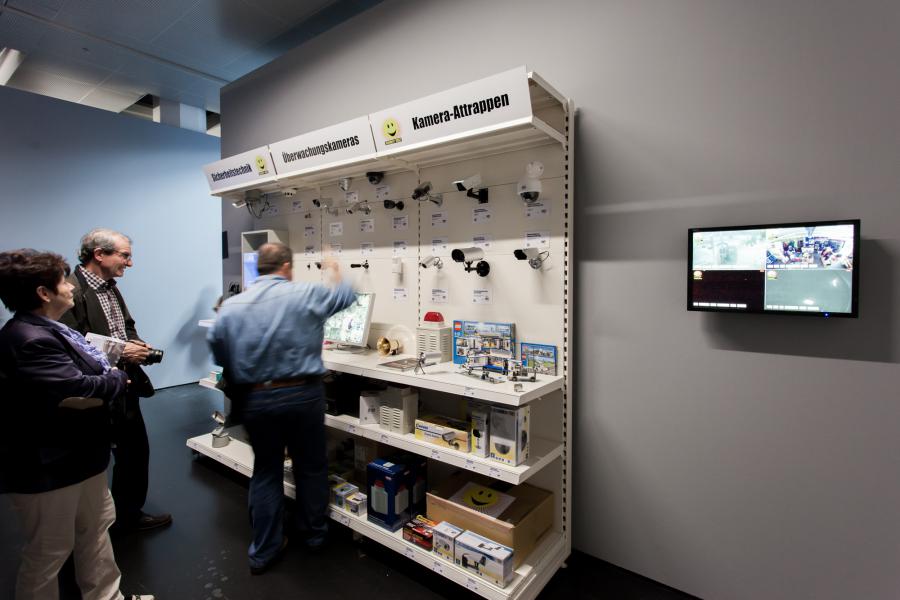
A long storage rack like one finds in an electronic appliances store displays all the products with which one can become part of the world of global surveillance; especially cameras, both real and dummies, visible as a deterrent or camouflaged as smoke detection devices or wall clocks. This hardware can also be used to upgrade one's private sphere so that one lives under the protection of electronic eyes. The following advertising announcement is heard via headphones:
«This is important: Make a clear choice to record and be recorded. Make a change. It’s your own individual right. We are the new generation. It’s a challenge, be virtually everywhere, create communities, network and exchange. Don’t escape and don’t occupy spaces, let them be open and free. And when you publish or talk to an algorithm, never be anonymous. Crime will fall rapidly. Our life will be better. Your choice is our choice.» An alternative to this vision are the shots from live webcams in real-time seen on the monitor. These images present a different truth: unsecured security cameras installed in private contexts upload unencrypted images to the Internet. Users can access these images via websites, but as the websites are not even password-protected, anyone can access the images. The private sphere may be safer, but at the price that it is less private. Text: Sebastian Althoff.


06:08 - By Unknown 0

Recent news

Discussion

Powered by Blogger.
back to top