Featured Posts

Decoration

All Posts
Showing posts with label INSTALLATION. Show all posts

Tuesday, 18 April 2017

LANGUAGE (PROPERTY), BY DANIEL ANDÚJAR


Daniel García Andújar – the Spanish media artist better known by his company name Technologies To The People — almost ten years ago created with Language (property) a work addressing the increasing privatization and commodification of language. A plain HTML page presents a list of sentences that have become registered trademarks and thus the property of their corporate owners. Examples include »Where do you want to go today?™« (Microsoft), »A better return on information ™« (SAP), »Moving at the speed of business™« (UPS), »What you never thought possible™« (Motorola). By giving his project the title Remember, language is not free™, Andújar anticipated the disputes surrounding ›intellectual property‹ in the following years (and increasingly evident in the second half of the 1990s with the ruthless scramble for domain names in the World Wide Web). While on the website the individual sentences are linked to the copyright notices of the relevant companies, a large-format, almost ›immersive‹, wall has been chosen for the exhibition.

13:52 - By Unknown 0

Wednesday, 21 December 2016

HI GENTLEMAN, BY ROZHGAR MUSTAFA


A Kurdish artist who lives in Sulaimani where she graduated from the university of fine arts in 2004, she teaches art in secondary school.
In her own words, Rozhgar Mustafa describes this artwork: "I used to produce my own bra when I was a teenager, because I couldn’t deal with my adulthood, my relatives told me that it is impossible to go out and play with my friends as because I passed my age twelve. Therefore I was thinking of hiding my breast to appear like a boy, and I usually had my hair cut by my brother as exactly as a boy for next four years. Since I had passed that period I always found myself under an extremely difficult social and political condition, which takes a decision based on my gender, from then I have been demanding the position of being a girl or a boy."


13:25 - By Unknown 0

Friday, 11 November 2016

2487, BY LUZ MARÍA SÁNCHEZ


2487 speaks the names of two thousand four hundred eighty-seven persons who were found dead throughout the border region of Mexico and the United States. Effectually giving voice to diaspora, Sanchez’s eight-channel sound piece evolves into an audible terrain where names are generated from various positions marking the varying directions of movement across the border. Each death, that was recorded and filed, has been audibly re-recorded and re-filed by the artist as individual sound files composed to play randomly, initiating organic patterns much like migration patterns themselves. Interspersed with varying periods of silence, some names are heard in isolation while others sound like links in a chain, and many overlap. As two thousand four hundred eighty-seven names are spoken the changing pace that speaks them disrupts any sense of repetition allowing the piece to extend beyond the serial monotony of name-calling. The random pattern employed in the voicing of these persons, these deaths, offers both moments of contemplation and anxiety with periods of doubt in between. That one can’t actually hear all the names, as some merge into others or are overlaid, underscores the immensity and gravity of what is being called for, not just called out—the intractability of 2487… and 2488, and 2489, and 2490 and… . More than just enunciating the sounds of each identity 2487 annunciates a calculated instability, a tension that quietly resonates throughout the piece.

A PDF with information about the individuals featured in 2487 is available for download here. For more information about Sánchez’s ongoing project on the Mexican diaspora, visit diaspora2487.org.

19:04 - By Unknown 0

Tuesday, 8 November 2016

OPERATION ONYMOUS (FBI INVESTIGATION OF THE SILK ROAD) AND CODE NAMES OF THE SURVEILLANCE STATE, BY TREVOR PAGLEN


As cyber threats increasingly push security efforts into virtual realms, Trevor Paglen’s work examines the many facets of government intelligence. Installed in a building that once served as home to the 902nd Military Intelligence Group — in a vault that housed classified documents — Operation Onymous (FBI Investigation of the Silk Road) invokes the motif of an FBI challenge coin, a cryptic medallion recognizing an agent’s affiliation with the organization; the coin featured here was given to those who aided the takedown of the notorious Silk Road darknet market in San Francisco. Code Names of the Surveillance State presents a scrolling list of more than 4,000 code names used by the National Security Agency (NSA) and Government Communications Headquarters (GCHQ) for surveillance programs.


18:51 - By Unknown 0

Tuesday, 1 November 2016

1 KG OF SOIL, BY AMER AKEL

Installation show in Kunsthalle Exnergasse (Vienna) 2015, in collaboration with Allartnow.

"What if the only remaining thing from Home is a few letters ... memories ...and a handful of soil....."
I didn't realise that obtaining handful Soil of Syria would be such a difficult mission. After numerous attempts that lasted a month and with some assistance from my friends I have managed to get 1kg of soil in order to achieve this project. It was a post journey from Damascus to Vienna... via Beirut...once I have received the postage and when I touched the soil I instantly had a strange feeling ...This is where the question of ' what is home?' has badly urged me (Amer Akel).


16:08 - By Unknown 0

Monday, 26 September 2016

LEVEL OF CONFIDENCE, BY RAFAEL LOZANO-HEMMER


"Level of Confidence" is an art project to commemorate the mass kidnapping of 43 students from the Ayotzinapa normalista school in Iguala, Guerrero, Mexico. It was released on March 26, 2015, exactly six months after the kidnapping took place. The project consists of a face-recognition camera that has been trained to tirelessly look for the faces of the disappeared students. As you stand in front of the camera, the system uses algorithms to find which student's facial features look most like yours and gives a "level of confidence" on how accurate the match is, in percent.

The biometric surveillance algorithms used, -Eigen, Fisher and LBPH-, are typically used by military and police forces to look for suspicious individuals whereas in this project they are used to search for victims instead. The piece will always fail to make a positive match, as we know that the students were likely murdered and burnt in a massacre where government, police forces and drug cartels were involved, but the commemorative side of the project is the relentless search for the students and the overlap of their image with the public's own facial features.


22:26 - By Unknown 0

Friday, 23 September 2016

SAY IT LOUD, BY SATCH HOYT


Satch Hoyt employs various media, including painting, drawing, sculpture, and installation that often incorporates sound. Also an accomplished musician and composer, he foregrounds musicality and aurality in his visual art. Using music as a lens, he investigates issues the ways in which people transform their environments, creatively reusing existing materials.

Hoyt is particularly interested in the African Diaspora and its complex international consequences. With Say It Loud (2004), he explores its cultural and political impact, arranging some 500 books on subjects related to black history in a podium-shaped stack arranged around a stepladder. Accompanying the installation is a recording of the chorus from James Brown’s “Say It Loud! I’m Black and I’m Proud!,” altered to mute the word “black.” Perched atop the stack is a microphone inviting viewers to consider the selective silencing of black voices, and to step up and perform their own concept of pride. Engaging viewers as both participants and collaborators, Hoyt underscores the open-endedness of black identity and empowerment.

22:11 - By Unknown 0

Monday, 29 August 2016

DE VLUCHT, BY WOUTER OSTERHOLT


The sugar sculpture is a copy of an existing monument, titled ‘De Vlucht’ (The Refuge) made by the Dutch sculptor Hein Koreman, located in the Valkenberg Park in the city center of Breda. Every year on the 4th of May this monument is used to commemorate the casualties of the Second World War, but in particular it reminds us of the so-called ‘Vlucht van Breda’. On the 12th of May 1940 the citizens of Breda fled their city due to the impending war.

09:00 - By Unknown 0

Saturday, 30 July 2016

RETURN OF THE ASHES, BY JAMISON CHAS BANKS


Known as “America’s favorite pastime,” baseball is the dominant metaphor for issues of contested territory in Retour des Cendres Vol. 1 (Return of the Ashes Vol. 1). In 1803 Napoleon sold the Louisiana Territory to the U.S., including the present-day state of Oklahoma as well as parts of fourteen other states, comprising the U.S.’s single largest acquisition of land. In this work the artist demonstrates a concern with interrelationship between the Louisiana Purchase, the exile of the Cherokee in Oklahoma, and Napoleon’s own later exile to the island of St. Helena.We encounter just a few elements—a scoreboard with a map of the United States, a vintage French flag, and a baseball with Napoleon’s signature—presented as artifacts of a game played between the “Exiles” and the “Purchasers.”

Artist's website

Jamison Chas Banks from SITE Santa Fe on Vimeo.
08:13 - By Unknown 0

Thursday, 7 July 2016

THE PRISON OF SANTO STEFANO, BY ROSELLA BISCOTTI


In The Prison of Santo Stefano (2011-2013), her work exhibited in the 13th Istanbul Biennial, Biscotti reflects on the general condition experienced by detainees and the psychological effects of isolation, which destroy physical and intellectual abilities and annul the convicts’ identities.
The Santo Stefano Prison is located on a small island on the Mediterranean Sea. It was the first prison built for life imprisonment in Italy and the first one to use a panoptic structure, taking as reference the San Carlo Opera Theater in Naples. Contemporary to Jeremy Bentham’s designs of the Panopticon, this structure renders all cells visible from a central point, thus creating a permanent feeling of surveillance. Santo Stefano opened its doors as a modern prison in 1793 and was operational until 1965. Many political figures in Italy—mostly anarchists and communist leaders— were imprisoned at this location.
In The Prison of Santo Stefano Biscotti produced imprints of spatial segments of the prison’s floors with lead sheets and filmed the process with 8 mm footage. This process —the carrying of the raw material to the island by hand, hammering and reshaping it, and taking it back to the mainland— symbolizes the prison’s existential conditions on many levels: it recalls the hard physical labour involved, represents the permanent marks the prison could leave on the body, and evokes a concrete sensation of the prison’s spatial restrictions through the sculptures shown as full-scale maps of one cell and a fragment of the courtyard. Biscotti is after the traces of the bodies who lived inside and capturing their resistance through fragility. In the film, the making of the sculptures is accompanied by a political action (‘Bringing flowers to the cemetery of the detainees that died in life imprisonment’) that was initiated by the artist and Nicola Valentino—former political prisoner with a life sentence—and supported by detainees of different Italian prisons. During 2012 and 2013, the unmarked graves of the island’s cemetery were named thanks to a map drawn by an anarchist that had visited the island shortly after the prison’s closure, and the action grew into the movement Liberi dall’ergastolo (‘Free from life imprisonment’).
Javier Villa and Övül Durmuşoğlu
10:00 - By Enrique Veganzones 0

Sunday, 26 June 2016

THE TWO FRIDAS, BY LAS YEGUAS DEL APOCALIPSIS


In 1987, Pedro Lemebel co-founded with Francisco Casas the collective Yeguas del Apocalipsis (The Mares of the Apocalypse), an arts performance group. The group performed in exhibitions and cultural events reaching its intended audience through actions that ranged from performance arts, video, installation, transvestism and photography. Many of their performances challenged the heteronormative social paradigms of gender and sex and invited individuals to reflect on the plight of minorities repressed under Pinochet and then further stigmatized with by the advent by AIDS.
The Two Fridas is the transvestite scenography of the painting by Mexican artist Frida Kahlo "The Two Fridas" (1939). In this reenactment, the setting of the members of the art group is reversed compared to the original painting. The artist on the right wears a typical Mexican dress and his heart is closed, whereas the one on the left wears a Victorian dress and has an open heart. They have bare torsos and oil paint on the skin, holding hands and connected through a blood catheter, just the way it is depicted in Frida Kahlo's painting.
19:08 - By Unknown 0

Wednesday, 27 April 2016

OUR NORTH IS THE SOUTH, BY JUAN JOSÉ MARTÍN


This installation aims at amazing the spectator when facing a map in which southern countries have occupied the territories of those in the north. What would happen if the geography of the European countries were distorted? Would this affect their economy, politics, society and culture?


22:12 - By Unknown 0

Friday, 26 February 2016

LOOKING FOR A HUSBAND WITH EU PASSPORT, BY TANIA OSTOJIĆ


In August 2000 Tanja Ostojić launched her project Looking for a Husband with EU Passport in which she published an online advertisement with the same title. Over the next few months the artist received numerous offers from men from around the world, and exchanged more than 500 letters with them. One of them was Klemens G. from Germany. Ostojić met him in 2001, as part of a publicly staged performance on the lawn in front of the Museum of Contemporary Art in Belgrade. One month later the two were wed in Belgrade, and then—with the international marriage certificate and other necessary documents in hand—Ostojić applied for a German visa. With her first three-month visa she moved to Düsseldorf, where she registered officially with the authorities and received additional visa extensions over the next three-and-a-half years. In the spring of 2005 her temporary residence permit expired and, instead of receiving a permanent residence permit, Ostojić was only granted an extension for an additional two years. Subsequently, she and Klemens G. divorced, and on July 1 the installation Integration Project Office was launched in the project room of Galerie 35 in Berlin, with a divorce celebration.
With her project Looking for a Husband with EU Passport Ostojić addresses the political injustices, exclusions, and delimitations that still exist in Europe beyond the global digital realm. Ostojić made use of the World Wide Web to shed light on the plight of immigrants and the limitations imposed on lifestyles, through artistic self-exploration.

Tanja Ostojić's website.
06:55 - By Unknown 1

NIKE GROUND, BY EVA AND FRANCO MATTES


Eva and Franco Mattes, born 1976, are the Brooklyn based artist-provocateurs behind the infamous Web site 0100101110101101.org. Since meeting in Madrid in 1994 they have never separated, living a nomadic life throughout Europe and the United States. Among the pioneers of the Net Art movement, they are renowned for their masterful subversion of public media. Over the last fifteen years, the Mattes’ have manipulated video games, Internet technologies, feature films, and street advertising to reveal truths concealed by contemporary society. Their works create a permanent state of insecurity by blurring borders between reality and fiction, art and offence, intention and action. Their off-the-wall performances—which have involved them in several lawsuits—include stealing dozens of fragments from art masterpieces (Stolen Pieces, 1995), rolling out a media campaign for a non-existent action movie (United We Stand, 2005) and even convincing the people of Vienna that Nike had purchased the city’s historic Karlsplatz and was about to rename it Nikeplatz (Nike Ground, 2003).


"We set up a fake Nike advertisement campaign using a website and a huge hi-tech container we installed in a public square in Vienna. The news went out nationwide: “Karlsplatz, one of Vienna’s main squares, is soon to be renamed Nikeplatz, and a huge monument in the shape of Nike’s famous Swoosh logo will be built in Nikeplatz”. The campaign provoked the reactions of Vienna’s citizens, city officials and the Nike group, which started legal action. Against all odds we won against the giant."
06:39 - By Unknown 0

BE CAREFUL WHO SEES YOU WHEN YOU DREAM, BY JENNY MARKETOU


The airborne installation features 18 red balloons inflated with helium, wireless CCTV, four video screens, and live video streaming. The aim of the artist is to shield the deep darkness of surveillance with aesthetic playfulness. The installation lures the visitors in enforceable encounters as they offer themselves as the watched subjects. Movements of visitors through the balloons are recorded as ephemera, traces, forms and patterns are broadcasted live in the four video screens set up on the floor of the gallery.

Jenny Marketou's website.
06:28 - By Unknown 0

SECURITY FIRST, BY MARC LEE


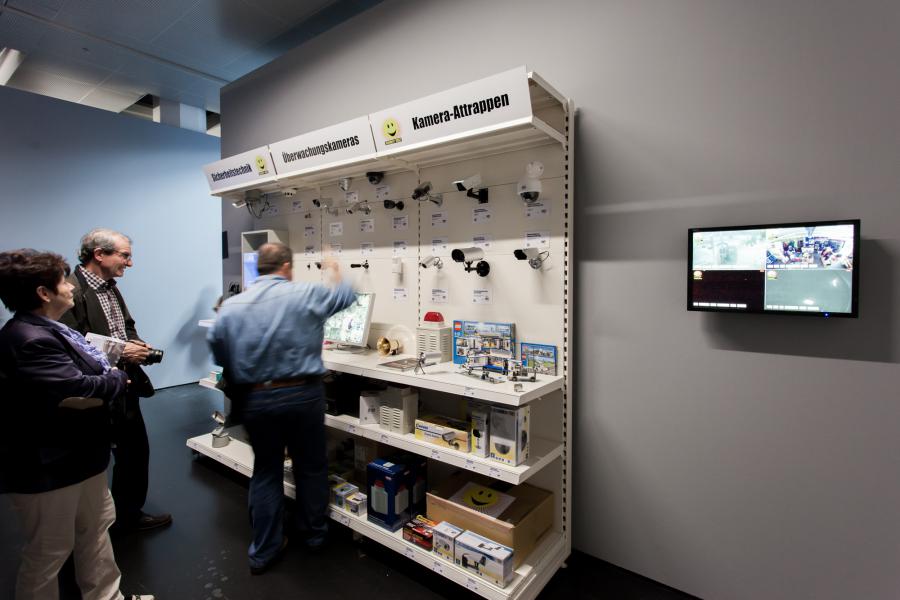
A long storage rack like one finds in an electronic appliances store displays all the products with which one can become part of the world of global surveillance; especially cameras, both real and dummies, visible as a deterrent or camouflaged as smoke detection devices or wall clocks. This hardware can also be used to upgrade one's private sphere so that one lives under the protection of electronic eyes. The following advertising announcement is heard via headphones:
«This is important: Make a clear choice to record and be recorded. Make a change. It’s your own individual right. We are the new generation. It’s a challenge, be virtually everywhere, create communities, network and exchange. Don’t escape and don’t occupy spaces, let them be open and free. And when you publish or talk to an algorithm, never be anonymous. Crime will fall rapidly. Our life will be better. Your choice is our choice.» An alternative to this vision are the shots from live webcams in real-time seen on the monitor. These images present a different truth: unsecured security cameras installed in private contexts upload unencrypted images to the Internet. Users can access these images via websites, but as the websites are not even password-protected, anyone can access the images. The private sphere may be safer, but at the price that it is less private. Text: Sebastian Althoff.


06:08 - By Unknown 0

Thursday, 25 February 2016

LOCATING SOCIAL (UN) AWARENESS, BY ANDREJA KULUNČIĆ


Technology is often just another tool for leaving others behind, and above all in favour for those who are skilled, equipped and able. That is why, when thinking about technology as a symbolic 'gate/passage', I could not avoid the question of social awareness. How to (conceptually, and in somewhat cynical gesture) into the 'discourse of mapping' the reality around us, introduce the reflection of attitudes toward the others, and the issue of social vulnerability? In fact, mapping in itself with its military and invading symbolism denies the 'awareness' towards the society, underlines the cynical, if not absurd idea of monitoring, locating, mapping and using thus in the name of freedom and democracy.
Do we want to know what people currently surrounding us think about the issue of asylum seekers, homosexual relationships, women's rights? Whether the people with whom we are in the same room are racist, sexist, homophobic? Wether our neighbours want equal payment for both sexes, and whether they would agree that all Russians living in Estonia receive Estonian citizenship?
Technology is here used to monitor not our actions, but our thoughts and attitudes. This method of 'thought-policing' is not used to separate the acceptable from unacceptable but first of all to question how important it is for us to share our social (un)awareness with others? Does it even matter?
The work starts from this last question. It should matter, and then with time we might correct our social (un)awareness and tacit acceptance of (un)awareness of our fellow citizens, politicians, and written laws.

Andreja Kulunčić's website.
22:29 - By Unknown 0

ARE YOU HUMAN, BY ARAM BARTHOLL


CAPTCHA codes are small images we encounter on the internet almost every day. To prove to the server that we are human we have to decode the distorted random letter-number word. CAPTCHA is the acronym for Completely Automated Public Turing test to tell Computers and Humans Apart and was developed in 2000. While at the Turing test humans were to decide if they chat with a program or another human. Today the computer is asking us if we were human. At the same time often it is quite difficult to decode these bend letters and numbers but spammers write specialized software which still is capable to do so. Are you human?
It is also interesting that CAPTCHA codes are generated by a script in the very moment a website is requested. In fact each code is unique but forgotten in digital nirvana very quickly. Once used (or failed) it will never appear as alike again. While many other files on the Internet are being copied and multiplied CAPTCHA codes stay in an ephemeral blind spot. They seem light, sometimes like a micro poem but they ask us the very existential question in an era of digital life.
18:40 - By Unknown 0

TRAPPED, BY ANNA TRAPENCIERE


The piece trapped was inspired by Rob van Kranenburg’s and Bruce Sterling’s ideas about “The Internet of Things.” The concept of the Internet of Things refers to one of the theories about the future of the Internet, where all everyday physical objects are interconnected and communicate among themselves in a virtual world of Internet.
One of the ways to link the physical entities to an online world is with RFID (radio frequency identification) technology, which is already widely used in agriculture and trade. By equipping over forty objects in her home with a small RFID tag and carrying around a RFID reader, Anna Trapenciere has created her own little Internet of Things. The RFID tags and the reader communicate with each other and provide data about the actions taking place in the network comprised of the artist, the RFID tags, and the reader. The information gained from the actions is visible to and traceable for everyone over the Internet.
The artist presents us with one form of life logging, recording her everyday actions by wearing a technological apparatus. The physical data, bodily movements, are transformed into readable electronic data. The information is displayed on the computer screen along with the date, time, and name of the activity.
Anna Trapenciere's website.

18:32 - By Unknown 0

Friday, 19 February 2016

DON'T LET THE MEDIA HAVE THE MONOPOLY ON THE FREEDOM OF SPEECH, BY FREEE


Don’t Let The Media Have The Monopoly On The Freedom Of Speech, poster, 2007; for solo exhibition Protest is Beautiful, 1000,000 mph Gallery, London. Also shown, How to Make a Difference, IPS, Birmingham, 2007, Terms of Use: Art and Informational Economy, Montehermoso, Vitoria, Spain 2008.

Freee art collective, composed of Dave Beech, Andy Hewitt, and Mel Jordan, questions the way in which public opinion is shaped, as well as the role of art in the public sphere. Working together since 2004, the artists have created publicly staged interventions using posters, screens, publications, journal articles, t-shirts, and slogans. The titles of their projects are typically very literal: The Economic Function of Public Art Is to Increase the Value of Private Property (2004) or Advertising Wants to Convert Our Desire for a Better Life into a Desire to Buy Something (2008).
Even though Freee’s visual and language-based interventions criticize the commercial and bureaucratic use of the urban environment, they occupy billboards, gallery spaces, and public sites. The group’s artistic strategy is dialectical: on the one hand, it draws from the avant-garde tradition by adopting the visual language of political dissents (for example, handwritten, handheld signs); on the other hand, it borrows mainstream media strategies, such as the use of big screens, and employ commercial-like aesthetics. Heavily influenced by Marxist theory, Freee aims at imagining a new social order by activating a collective and participatory space.

22:42 - By Unknown 0

Recent news

Discussion

Powered by Blogger.
back to top